Excerpts from
The
Life Magnet Vol. 2
by
Robert Collier
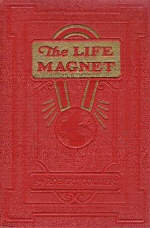
Order in Adobe PDF eBook or printed form for $5.95 (+ printing charge)

Book
Description
This is part of a set of 7 books that Robert Collier
published in 1928 as a follow-up series to his highly successful
"Secret of the Ages.". The first 2 books in this series were entitled
"The Secret of Gold", and the remaining 5 were entitled "The Life
Magnet." Original copies of this series are now very hard to find.
The chapter titles of this volume are:
Chapter
1 - Discouragement
Chapter
2 - The Black Mountain
Chapter
3 - The Dragon’s Teeth
Chapter
4 - The
Unifying Fire—Love and Marriage
Chapter
5 - The Moulting Period
What These Books Will Do for You
"The Life Magnet" will show you how
to get what you want--how to draw to yourself riches and power
just as surely as the magnet draws to itself every filing of iron that
comes within its reach. There is nothing of good you can ask for, that
it cannot bring you.
Scientists tell us, you know, that all mankind is created
equal----that
the brain of one man is exactly the same as that of another. The only
difference between a failure and a successful man is that the
successful man's brain is more developed.
But here is the important part--These scientists tell us
that no
man has found the way to use more than one tenth of
the giant power of his brain. And the prime purpose of "The Life
Magnet" is to point out in plain language the way to harness the vast
reserve power of this Giant Inside You--the way to use it to
bring you whatever you want.
There are no vague theories in these books. They show you
first
just
what is this giant unused power within you, then how to reach it and
finally how to make it work for you every day and hour.
Chapter
1
Discouragement
"Keep thy heart with all
diligence,
for out of it are the issues of life." —Proverbs 4:23.
YEARS ago I read a story about
a man who had become so
discouraged that he decided to commit suicide.
He had married a widow, and she
not only made life a burden
for him at home, but spent all his savings, ran him into debt and
discredited
him with his employers.
He could see only one way
out—to jump into the river and
end his troubles.
It was
Saturday night, so, waiting until late, he slipped out of the
house and down
through the deserted streets to the bridge.
Imagine the grim humor of it
when, from out of the shadow
of one of the great stone towers, a man with a gun stepped forth and
commanded—"Hands up!"
Automatically, the discouraged
man obeyed, then brought his
hands down again as the humor of it gripped him. If this highwayman
wanted to
save him the trouble of killing himself, let him!
But the highwayman wasn't that
obliging. Being a bigger
man, he seized the other, held him tightly while he went through the
pockets
the wife had emptied hours before, then turned him loose and looked him
over
curiously.
"What's the joke?" he asked
roughly, as the
intended suicide yielded to another paroxysm of laughter.
Between gasps, the man told him.
"Hum," mused the highwayman,
immediately
interested, "you ought not to do that. Why don't you just leave the
woman?
Leave her and start fresh somewhere else."
But the other was too
discouraged. His mind was made up. He
was going to put an end to his troubles once and for all.
"Well, do this much, anyway,"
suggested the
highwayman. "Give fate a chance. Don't just jump off the bridge, but
climb
up on the railing there and see how far you can walk. You'll fall over
before
you've gone far. If you fall on that side—all right, you're a goner and
that's
the end of it. But if you fall on this side, go back home and give life
one
more try.
The would-be suicide agreed—so
the other
boosted him up on to
the rail and he started. Before he
had gone
twenty feet, he was down—and glad
enough, if
the truth were told, to fall on the bridge side after looking so close
into the
jaws of death.
His new-found friend picked him
up and helped him home,
where Fate chose that opportune moment to show him that the greater the
obstacle, the bigger stepping-stone to success it can be made.
But perhaps you will say that
only happens in stories.
Read the lives of the great and you will never say it again. The
difference
between failure and success is measured only by your patience and
faith—sometimes by inches, sometimes by minutes, sometimes by the
merest
flash of time.
Take Lincoln, He went into the
Black Hawk war a Captain —and
came out a private. His store failed—and his survey-or's instruments,
on which
he depended to eke out a livelihood, were sold for part
of the debts. He was
defeated in his
first try for the Legislature. Defeated in his first attempt for
Congress.
Defeated in his application for Commissioner of the General Land
Office.
Defeated for the Senate. Defeated for the nomination for the Vice
Presid-ency
in 1856. But did he let that long succession of defeats discourage him?
Not he.
He held the faith—and made perhaps the greatest President we have ever
had.
"He shall not fail nor be
discouraged," promised
Isaiah (42:4,6), "till he have set judgment in the earth; and the isles
shall wait for his law. Thus saith God the Lord: I the Lord have called
thee in
righteousness, and will hold thine hand, and will keep thee."
Then there was Grant. He failed
of advancement in the army.
Failed as a farmer. Failed as a business man. At 39, he was chopping
and
delivering cord-wood to keep body and soul together. Nine years later
he was
President of the United States and had won a martial renown second in
this
country only to Washington's.
Search the pages of history.
You will find them dotted with
the names of men whom the world had given up as failures, but who held
on to
their faith, who kept themselves prepared—and when their chance came
they were
ready and seized it with both hands.
Napoleon, Cromwell, Patrick
Henry, Paul Jones—these are
only a few out of thousands.
When Caesar was sent to conquer
Gaul, his friends found him
one day in a fit of utter despondency. Asked what the matter was, he
told them
he had just been comparing his accomplishments with Alexander's. At his
age,
Alexander had conquered the entire known world—and what had Caesar done
to
compare with that?
But he presently roused himself
from his discouragement by
resolving to make up as quickly as might be for his lost time. The
result? He
became the head of the Roman Empire.
"Behold, the Lord thy God hath
set the land before
thee; go up and possess it, as the Lord God of thy fathers hath said
unto thee;
fear not, neither be discouraged."
—Deuteronomy
1:21.
The records of business are
crowded with the names of
middle-aged nobodies who lived to build great fortunes, vast
institutions. No
man has failed as long as he has faith in the Father, faith in the
great scheme
of things, faith in himself.
But it takes the kind of simple
faith that F. S. Shinn
tells of in The Game of Life and How to Play It. . .
A woman was looking for an
apartment in New York at the
time when apartments were scarcely to be had for love or money.
Her friends told her she would
have to store her furniture
and live in a hotel. But she held on to her fath. She knew that
somewhere was
just the apartment she was seeking—and that the Father knew exactly
where that
apartment was. So she prayed to Him to open the way—prayed in the full
confidence that there is a supply for every demand, that her eyes had
only to
be opened as were Hagar's in the desert.
She knew that if she found the
apartment she was going to
need new blankets for the winter. But caution said—wait until you find
an
apartment to put them in. Faith made answer—"Whatsoever ye ask for when
ye
pray, believe that ye receive it!"
What would the first thing be
that she would do if she had
the right apartment? Buy blankets. All right, if she had Faith in the
Father,
she must show her belief. So she went out and bought the blankets.
Needless to say she got the
apartment—in what F. S. Shinn
describes as a "miraculous way" and in spite of the fact that there
were 200 other applicants for the same apartment. She had shown her
faith.
Yesterday
Ended Last Night
When Robert Bruce faced the
English at the battle of
Bannockburn, he had behind him years of failure years of fruitless
efforts to
drive the English out of Scotland, years of heart-breaking toil in
trying to
unite the warring elements among the Scotch themselves. True, at the
moment a
large part of Scotland was in his hands, but so had it been several
times
before, only to be wrested from him as soon as the English brought
together a
large enough army.
And now in front of him stood
the greatest army England had
ever gathered to her banners—hardy veterans from the French Provinces,
all the
great English nobles with their armored followers, wild Irish, Welsh
bowmen—troops from all the dominions of Edward II, over 100,000 men—to
conquer
whom Bruce had been able to muster but 30,000 men,
brave and hardy, it is true, but lacking the training
and
discipline of the English.
Was Bruce discouraged? Not he.
What though the English had
the better archers. What though they were better armed, better trained,
better
disciplined. He was fighting for freedom—and he believed in
himself, he
believed in his men, he believed in the God of battles.
And, as always, weight,
numbers, armament, proved of no
avail when confronted with preparation and faith. The vast English
host was
completely defeated and dispersed. Bruce was firmly seated upon the
throne of
Scotland, and never more did an invading English army cross its borders.
In Joshua (6 and 7) the
Scriptures tell how the Midianites
and the Amalekites lay along in the valley like grass-hoppers for
multitude,
and had driven the children of Israel into caves in the mountains.
And how
Gideon gathered the Israelites together to the number of 30,000 to
fight them.
But the Lord said unto Gideon:
"The people that are
with thee are too many for me to give the Midianites into their hands,
lest
Israel vaunt themselves against me, saying, Mine own hand hath saved
me."
So Gideon told all who were
fearful and afraid to depart.
And 20,000 left. But still there were too many. So Gideon put the
10,000 that
remained to another test, until of the original 30,000, he had only 300
men!
"And the Lord said unto Gideon:
By the three hundred
will I save you, and deliver the Midianites into thine hand.
"And it came to pass the same
night, that the Lord
said unto him: Arise, get thee down unto the host; for I have delivered
it into
thine hand.
"And the three companies blew
the trumpets, and brake
the pitchers, and held the lamps in their left hands, and the trumpets
in their
right hands, to blow withal; and they cried, The Sword of the Lord and
of
Gideon.
"And they stood every man in
his place around about
the camp; and all the host ran, and cried, and fled."
Never mind how many defeats you
have suffered in the past.
Don't be concerned about how great the odds may be against you.
Below put it
well when he said—"It's not the size of the dog in the fight that
counts,
so much as the size of fight in the dog." And the size of fight in you
depends upon your faith—your faith in yourself, in your Father and in
your
cause. Just remember that yesterday ended last night, and
yesterday's defeats
with it.
The power which counts is not
wealth or weight or numbers
or any power that comes from without—but the power that comes from
within, the
power of the Father. With Him arrayed on your side, you are always in
the
majority. You don't need to become a success—you are a
success
from the moment you become at one with the Father. "Acquaint now
thyself
with God and be at peace." Cast your burden upon the Father—and go
free.
He can carry it. In fact, from the moment you can truly cast it upon
Him, it
ceases to be a burden.
"Come to me, all ye that labor
and are heavy laden,
and I will give you rest." Time after time throughout the Bible we are
told
that the battle is not ours—but the Lord's. But like all children, we
know so
much better than the Father how our affairs should be handled that we
insist
upon running them ourselves.
Is it any wonder they get so
tangled as to leave us in the
depths of discouragement?
We insist upon having our
birthright, and we go into a far
country (away from the Father) and lose it. And then how few of us have
the
courage to come back to the Father, to own up that we have sinned and
are
unworthy to be called His sons. We would rather feed upon the husks of
discour-agement
and despondency than come back and throw ourselves upon the
Father's mercy,
leaving the future in His hands, taking His yoke upon us. Yet he
assures us—"My
yoke is easy and my burden light."
Have you ever, as a child, got
into mischief, tried to
conceal it from your parents, then gotten in deeper and deeper
until finally,
in despair, you went to them and made a clean breast of the whole
thing?
Remember what a relief it was to transfer that load of worry and fear
from your
small shoulders to their strong ones? Remember how willing you were to
assume
any "yoke," to suffer any punishment they might inflict, in order
to
get rid of that crushing weight of worry?
The Father above is as loving,
as tender, as merciful as
any earthly parent can possibly be, so why not carry your worries to
Him in the
same spirit?
"Invited
Guests"
"A
crowd of troubles passed him by
As
he with courage waited,
He
said: "Where do you troubles fly
When
you are thus belated?'
'We
go,' they said, to those who mope,
Who
look on life dejected.
Who
meekly say good-bye to hope.
We
go—where we're expected!"
—F.
E. Allison.
When the Black Prince with his
little army was penned in by
Philip of France, most men would have felt discouraged. For the hosts
of France
seemed as numerous as the leaves on the trees, while the English
were few, and
mostly archers. And archers, in that day, were believed to stand no
chance
against such armored knights as rode behind the banners of Philip.
The French came forward in a
great mass, thinking to ride
right over that little band of English. But did the Black Prince
give way? Not
he. He showed the world that a new force had come into warfare, a force
that
would soon make the armored knight as extinct as the dodo. That force
was the
common soldier—the archer.
Just as the Scotch spearmen
overthrew the chivalry of
England on the field of Bannockburn, just as infantry have
overthrown both
cavalry and artillery in many a later battle, so did the "common men"
of England—the archers—decide the fate of the French at Crecy. From
being
despised and looked down upon by every young upstart with armor upon
his back,
the "common men"—the spearmen and archers—became the backbone of
every successful army. And from what looked like certain annihilation,
the
Black Prince by his faith in himself and his men became one of the
greatest
conquerors of his day.
Troubles flocked to him, but he
didn't recognize them as
troubles—he thought them opportunities. And used them to raise himself
and his
soldiers to the pinnacle of success.
"Have I not commanded thee? Be
strong and of a good
courage; be not afraid, neither be thou dismayed; for the Lord thy God
is with
thee whithersoever thou goest."
—Joshua 1:9.
There are just as many prizes
in business as in war—just
as many opportunities to turn seeming troubles into blessings. But
those prizes
go to the men like the Black Prince who don't know a trouble when they
meet
it—who welcome it, take it to their bosoms, and get from it their
greatest
blessings.
I know a man who was "stuck"
with 50,000
traveling bags —and the bank was pressing him to repay the money it had
loaned
on them.
Did he weep? Did he get
discouraged and quit? Not he! He
developed a brand new market, an entirely new list he had never even
thought of
before, and not only sold his 50,000, but a lot more besides.
I know another man who was
selling a special kind of
poultry feed shortly after the war. And poultry feed seemed so in
demand that
he contracted for ten carloads of it. A few months passed, and the
bottom
dropped out of the market—leaving him with a warehouse full of poultry
feed,
and five more cars to come!
Did he get discouraged and
quit? Not he! He got up a prize
contest, that so stimulated the interest in poultry feed that he sold
not only
all that he had, not alone the five cars on the way, but three
additional
carloads!
Nearly every man can look
back—and not so far back either
with most of us—and recall cases like that where, by facing
seeming troubles
determinedly, he opened up entirely new resources, turned seeming
troubles into
his greatest blessings.
You can treat ALL troubles that
same way, if you will just
hold the faith, resist discouragement, and call upon the Father for
help.
But yield to discouragement,
and even though good come of
your trial, you will lose the key to it. You will be like the man who
knew that
somewhere along the ocean shore was a pebble that would turn iron into
gold. He
started out full of hope and enthusiasm, picking up pebbles and
touching them
to the iron bracelet he wore.
But after a time he became
discouraged. He still walked
on, picking up pebbles, touching them to the bracelet and throwing them
down
again, but he did it mechanically, paying no attention to what he was
doing.
As the sun was setting, he
glanced down at the bracelet—to
find, to his astonishment, that it was turned to gold!
But, alas! The stone that did
it was lost, somewhere back
along his way. He had held it—used it—and thrown it away!
What is the use of holding on
to life—unless you at the
same time hold on to your faith? What is the use of going through the
daily
grind, the wearisome drudgery—if you have given up hoping for the
rewards, and
unseeing let them pass you by?
Suppose business and industry
did that? How far would they
get? It is simply by holding on hopefully, believing, watchfully—as
Kipling put
it: "Forcing heart and nerve and sinew to serve your turn long
after they
are gone, and so hold on when there is nothing in you except the will
which
says to them: 'Hold on'!"—that many a business man has worked out
his
salvation.
Take the metal mines, as an
instance: Supposedly worthless
mines have now become productive, slag heaps have suddenly become
worth
millions, all through a froth that was discovered almost by accident!
Writing in The Compressed
Air Magazine, Gail Martin
says: "Froth is raising millions of tons of minerals each year to a
state
of high commercial value. An oily, fluffy, dirty-grey froth is
separating complex
minerals into valuable products. Difficult smelting problems have been
overcome; waste has been converted into profitable ore; and all through
the
discovery that froth can he made to accomplish what no other known
agency will
do as effectively. Three years ago, plants in Salt Lake Valley poured
on their
slag dumps daily about 100,000 pounds of zinc—$2,000,000 worth
annually. Today,
the greater part of this metal is saved."
But do you suppose it would
ever have been saved if
industry had simply sat back discouraged, or if, like the man on the
seashore,
its efforts had been merely mechanical?
It is not enough to work. The
horse and the ox do that. And
when we work without thought, without hope, we are no better than they.
It is
not enough to merely hold on. The poorest creatures often do that
mechanically,
for lack of the courage to let go.
If you are to gain the reward
of your labors, if you are to
find relief from your drudgery, you have got to hold on hopefully,
believingly, confidently—knowing that the answer is in the great heart
of the
Father, knowing that He is not only willing but anxious to give it to
you, the
moment you have prepared yourself to receive it.
It is never the gifts that are
lacking. It is never the
Father who is backward in answering our desires. It is we who are unable to see, who fail to recognize the good,
because our
thoughts are all of discouragement and lack. We dwell on the evil
we see
around us—and troubles come a-flocking around our heads. When all we
need to do
is to disclaim the evil and look for the good that is rightfully
ours—and the
Father's good gifts will compass us about.
"This book of the law shall not
depart out of thy mouth; but thou shall meditate therein day and night,
that
thou mayest observe to do according to all that is written therein: for
then
thou shall make thy way prosperous, and then thou shalt have good
success." —Joshua 1:8.
Order complete book in Adobe PDF eBook or printed form for $5.95 (+
printing charge)
|