Excerpts from
The
Life Magnet Vol. 1
by
Robert Collier
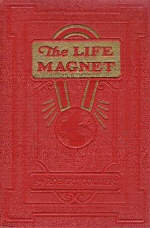
Order in Adobe PDF eBook or printed form for $5.95 (+ printing charge)

Book
Description
This is part of a set of 7 books that Robert Collier
published in 1928 as a follow-up series to his highly successful
"Secret of the Ages.". The first 2 books in this series were entitled
"The Secret of Gold", and the remaining 5 were entitled "The Life
Magnet." Original copies of this series are now very hard to find.
The chapter titles of this volume are: The Promise; The Golden
Calf; The Four Keys to Success; The Forward Look.
What These Books Will Do for You
"The Life Magnet" will show you how
to get what you want--how to draw to yourself riches and power
just as surely as the magnet draws to itself every filing of iron that
comes within its reach. There is nothing of good you can ask for, that
it cannot bring you.
Scientists tell us, you know, that all mankind is created
equal----that
the brain of one man is exactly the same as that of another. The only
difference between a failure and a successful man is that the
successful man's brain is more developed.
But here is the important part--These scientists tell us
that no
man has found the way to use more than one tenth of
the giant power of his brain. And the prime purpose of "The Life
Magnet" is to point out in plain language the way to harness the vast
reserve power of this Giant Inside You--the way to use it to
bring you whatever you want.
There are no vague theories in these books. They show you
first
just
what is this giant unused power within you, then how to reach it and
finally how to make it work for you every day and hour.
The
Promise
"For the earth shall be full of lie knowledge of the Lord, as the
waters cover the sea." — ISAIAH 11:9.
WHAT was the greatest terror of primitive man? What, even in the golden
days of Greece and Rome, was thought to be the wrath of God? What,
right down to the begin-ning of the last century, seemed the most
wholly destructive force in creation?
The Lightning.
Primitive man crouched in his cave in abject fear when the thunder
rolled and lightning darted out of the sky, taking its toll of
devastation and death. He might flee from his enemies of the jungle. He
might overcome his savage adversaries. But when the lightning sought
him out—that, indeed, to him was the wrath of God.
When Benjamin Franklin with his kite drew lightning quietly from the
clouds, he drew out of them a lot more than a mere current of
electricity. He drew one great dread from the soul of man.
For thousands of years this greatest force in the material universe had
roamed the world unleased—the terror of man-kind—a powerful
Genii uncontrolled, loose in a land of pigmies. And all the
while it stood there ready and waiting to be harnessed, lashing out
impatiently at times at man's failure to grasp the availa-bility of
this wonderful servant standing at his very elbow.
Just so it is with the greatest Genii of them all—the subconscious mind
within you.
Through this spirit within, you can do anything right you may wish. If
there is an unpardonable sin, it is to ignore or neglect it. For there
is nothing right you can ask of it that it cannot give you.
Since publishing the first two vol-umes of this set, many people have
writ-ten me that the ideas outlined in them seem wonderfully hopeful,
wonderfully promising—but how can they know them to be true?
The promises in them were made through Prophets, through Apostles,
through Christ Himself—they are taken word for word from the Bible—but
what proof have I that the Bible is to be be-lieved? What proof,
indeed, have I that there is a God at all—much less a Divine Plan that
takes cognizance of such unim-portant creatures as ourselves?
Well, let us see. Science is generally supposed to be at odds with the
Bible, so let us see what science has to say about the question of a
God.
Dr. Michael Pupin, Professor of Elec-tro-mechanics at Columbia
Univ-ersity, is an acknowledged authority on things electrical
and scientific. Let us get his opinion:
The only mystery in connection with electrical science, he tells us, is
the ques-tion of the origin of the proton and the electron. And that
baffling question of when, where and how the tiny electron and its
partner the proton came into ex-istence can only be answered, he
contin-ues, by saying—"God created them."
Dr. Pupin asserted that when man dis-covered the electrons he
discovered the oldest and most efficient workers and the most
law-abiding servants in the cosmic universe. When man learned how to
employ their services, he caught the first glimpse of the divine method
of creative operations.
God created the electrons to be His assistants in the creation of the
universe.
The electron is the most law abiding creature in the universe; the most
ordi-nary intelligence can manage it. It loves, honors and obeys the
law and its eternal mission is to serve. It is the ser-vice of the
electron which carries the human voice around the terrestrial globe; it
carries the power from coal mines and mountain streams to our homes and
makes us comfortable; it pulls our sub-way trains.
To teach electrical science as it ought to be taught, Dr. Pupin said,
is to teach theology in its most concrete and intel-ligible form, It is
the electrons, consti-tuting an infinitely numerous host of law-abiding
celestial workers, which the Milton of today can glorify just as the
Milton of 300 years ago glorified his heavenly hosts of angels.
God employed the heavenly host of electronic workers to build the
atoms, the molecules and the galaxies of burning stars. These celestial
furnaces, throb-bing with the blazing energy of the elec-tronic host,
are molding all kinds of plan-etary castings and tempering them so as
to be just right for organic life.
Thus Dr. Pupin. Nothing at odds with religion in it, is there? It all
goes back to the one great Source. Every-thing is made of protons and
electrons. Everything consists of electrical energy. BUT—
Who Made the Electrical Energy?
There can be but one answer — GOD. What matters whether you call Him
God or Nature or Mind or merely the Crea-tor? So long as you ascribe to
Him His attributes of all-power, all-presence, all-life and
all-love—what does the name you give Him matter?
So much for the science of electricity. Let us see what the doctors
say. They have taken apart everything that is in man's body. They have
analyzed all its elements. They know exactly of what we are made. But
though they have ex-plored every nook and cranny of the brain—living
and dead—they have never found a thought, they have never discov-ered
what makes it work. Just listen to what Dr. Charles Mayo, one of the
foremost surgeons of the day, has to say:
"Like the small boy with the watch," he says, "we have taken man's form
apart and put it together again. But we are still hazy about the force
that makes it run."
Any great surgeon could put together the mechanical organs of a man. He
might even, with the right electrical con-trivances, force the heart to
do its work; send the blood coursing through the ar-teries, the veins,
through the brain itself. As a matter of fact, it was recently
an-nounced that a Russian scientist has in-vented an electrical device
which can take the place of the heart. But the greatest surgeon in the
world cannot make the creature of his hands live, cannot make it think,
cannot make it work for one minute longer than his outside agencies
propel it.
In short, man can put together all the component parts of any machine,
even the machine of the body. But he cannot sup-ply
the soul that runs it. He cannot breathe into it the spark of
life. Only God can do that!
So much for the doctors. Now let us hear from the chemists, the men who
have analyzed all elements:
"There are about a hundred elements," says John Gunther in The Red
Pavilion. "When you finish listing the first eight or so, then you find
that the second group forms a new series analogous to the first series.
That is, you start over again with number nine, which is neon, and you
find neon almost identical in properties with number one, which is
helium. Both are inert gases. Andnumberten (sodium) is almost precisely
similar to number two (lithium). And number eleven, which is magnesium,
corre-sponds exactly with number three, which is beryllium. Do you see?
Each group runs its gamut, shades from the one end to the other, and
then repeats itself in an ascending order.
"I speak, of course, very loosely. But you must see what I am getting
at. Any-way, when you get all the elements lined up you find them
arranged in families both ways—up and down the pattern. Each element
has a particular place in the scheme of things. Each element has its
fore-ordained nook and cranny. You can't move it. It fits. It fits
there mathe-matically.
"Isn't that superb? Don't you see, it shows that all matter—everything
in the world—belongs somewhere, fits in its place in the scheme of
things. No one knows why it happens that way. No one can know. It just
is. In a perfectly mystical way each element, and thus all matter,
finds its position and stands there like a good soldier—for eternity.
"And that isn't all. When Mendeleef announced the law some elements
were undiscovered. The pattern was not com-plete. There are still some
elements not discovered for that matter. But before the elements came
to light Mendeleef was able to predict what they would be. He filled
the gaps in his chart with hypo-thetical elements, and after his death
these same elements, just as he predicted them, were discovered.
"I think that's the most stupendous thing in the world. I think it is
some-what frightening. To think of elements of matter, unborn, so to
speak, waiting for the day of their emergence, waiting patiently, and
all the time, though we can't find them, can't isolate them, we know
their names, their weights, their properties, even their colours.
"It is like a vast and thrilling battle. We on our side wait because we
know some time that element must come out of hiding and take his place
with the rest and fit in the supernal pattern which is ready—and on the
other side the elements also wait, they hide deep in ore and crust and
earth and defy us to prove that we are right, that we know better than
they. They are unborn, but we know they must be born and finally they
come.
"And all the time the pattern is com-plete and every unit—including the
un-discovered ones—is at work.
"Well, now that's why I suppose I must be honest and say I do believe
in some kind of directed force which, if you want to, you can call God."
Sounds like taking a long way around, of course, but the Science of
Chemistry brings you home to the same goal at the last, doesn't
it? For—"Who knoweth not in all these that the
hand of the Lord hath wrought this?"—Job 12:9.
Then there is the astronomer, the stu-dent of the heavens—of "the older
Scrip-ture, writ by God's own hand." To quote Young—"An undevout
astronomer is mad." And truly, the astronomer who did not believe in
God would be an anom-aly, for the Hand that can hold a billion worlds
to their appointed courses must be nothing less than Divine.
"The heavens declare the glory of God: and the firmament sheweth his
handywork.
"Day unto day uttereth speech, and night unto night sheweth knowledge.
"When I consider thy heavens, the work of thy fingers; the moon and the
stars, which thou hast or-dained;
"What is man, that thou art mindful of him? and the son of man, that
thou visitest him?
"For thou hast made him a little lower than the angels, and hast
crowned him with glory and honour.
"Thou madest him to have dominion over the works of thy hands: thou
hast put all things under his feet."—Psalms 19:1-6.
More than a hundred years ago, an as-tronomer named Paley presented the
case for God so clearly that I cannot do bet-ter than reproduce it here.
"I lay on the table before you a watch," said Paley, "a complicated
arrangement of wheels, springs, jewels, pivots, and balances, all
neatly combined in a case and covered with a crystal.
"I tell you that the watch had no maker; that out of the bowels of the
earth came iron and gold, and the elements of glass; that they refined
themselves, fash-ioned themselves into springs and wheels and crystal,
assembled themselves into this case, wound themselves up and started to
tick, I tell you all this and you tell me I am a fool. You say that my
story violates your reason; that the exis-tence of the watch is
positive evidence of the pre-existence of a watchmaker.
"And yet I show you a far more tre-mendous mechanism—a watch whose
parts are planets and stars, suspended in limitless space, moving in
unvarying orbits, each perfectly adjusted to all the others—and you
say: 'It is a mystery beyond our understanding. It must have happened.
There is no evidence of an Intelligence; no proof of a Plan.'"
Your real scientist is in no doubt about the existence of God. He never
ques-tions it. He has as much reverence and respect for the Creator as
you or I. It is your fledgling, your dabbler in science that is so
cocksure that the Prophets of old, the Apostles—Jesus Himself—were mere
tyros. He knows more than they.
"A little learning is a dangerous thing," Says Pope. "Drink deep, or
taste not the Pierian spring. There shallow drafts intoxicate the
brain, and drinking largely sobers us again."
Darwin never said that man was de-scended from the monkey. Read his
Origin of Species. You will find no such statement in it. What he did
say was that, from the study of all the facts known to science in his
day, the conclusion that the monkey was a progenitor of man seemed to
be a logical deduction. But—that was years ago—and science has made
many new deductions since then.
"Ape Man Theory Now Discarded!"
That is the headline I read in the New York Herald-Tribune on April 30
last. At the convention of the American Philosophical Society, Dr.
Henry F. Osborn, President of the American Museum of Natural History,
branded the theory that man is descended from the ape as totally false
and misleading. It should be banished from our literature, not on
senti-mental or religious grounds, but on purely scientific grounds.
"Of all incomprehensible things in the universe, man stands in the
front rank," Dr. Osborn concluded, "and of all in-comprehensible things
in man the su-preme difficulty centers in the human brain,
intelligence, memory, aspirations, powers of discovery, research and
the conquest of obstacles." In other words, something far higher than a
monkey must have conceived the soul.
Science, in short, is back where it started from. With a little
knowledge, it could tell all about man. But the more it learned, the
less sure it became. Until now it frankly admits the origin of man to
be incomprehensible—unless you accept the plain fact that as long as
God was the origin of life, as long as He is the Direct-ing
Intelligence behind the universe, it would be no more wonderful—nor any
more difficult—for Him to have evolved man complete and perfect as in
the Scrip-tural accounts than to have brought him through all the
different stages of devel-opment outlined by the scientists. In either
case, we are back to the words of Job (33:4): "The Spirit of God hath
made me, and the breath of the Almighty hath given me life."
Let us see where that brings us. Scien-tists are agreed, we find, that
there is a God—though some prefer to call Him by some other name. They
are agreed that He is the origin of life. The point on which they
disagree is merely how He manifested that life—whether He cre-ated
everything complete and perfect, or started in with the lowest form and
from it gradually developed up to the highest.
Science and religion are not so far apart then, after all!
But how about the Bible? How about the Book upon which our whole
religion is founded? What have they to say of it?
For a long time, many scientists had only disparaging things to say of
it—that it was a mere collections of traditions, handed down from
father to son through endless generations. That it was no more reliable
than the Folk-lore of the Norse-men or the Mythology of the Greeks and
Romans.
But for some years past, archaeologists have been excavating in Egypt
and the Holy Land and throughout the territory covered by the Biblical
records, and the facts they have dug up have established beyond
question the historical accuracy of many, at least, of the Scriptural
chron-icles.
To begin with, there undoubtedly was a flood. The record of it appears
in the ancient writings of all the Eastern peoples. Tablets of clay and
tablets of stone, writings of wax and rolls of papy-rus, all bear
witness to this great catas-trophe.
On a tablet dug from the ruins of an-cient Ninevah by George Smith of
the British Museum and translated by Prof. Haupt of Johns Hopkins
University, there is given a complete description of the Ark.
Professor Haupt's translation relates how Noah cut down trees in the
jungle and laid the frame of his ark, which con-sisted of six decks,
divided into seven compartments. After its cargo was taken aboard,
Professor Haupt said, two-thirds of the ark was under water.
"For our food," read Professor Haupt's translation of the tablet, "I
slaughtered oxen and killed sheep—day by day, With beer and brandy, oil
and wine I filled large jars, as with the water of a river."
Then there is the Tower of Babel. In Ur of the Chaldeas, excavators
from the University of Pennsylvania uncovered what looked like a huge
rubbish heap, but proved to be an immense pyramid temple, a staged
tower 195 feet long, 150 feet wide and 60 feet high. To quote P.W.
Wilson:
"It is what Chaldea meant by Babel. And a work so immense could only
have been completed by a community politi-cally united. The Scriptural
statement, therefore, that the building was interrupted by a confusion
of tongues—that is, by a divergence of race and culture—is rendered
self-evident."
The mosque of Hebron covers a cave which corresponds exactly with that
grotto of Machpelah which Abraham bought for the burial of his dead.
And it contains the ancient coffins of that pa-triarchal family. One
curious confirm-ing fact, too. The coffin of Rachel is not there.
Remember, in the Scriptural rec-ord, how she died suddenly and had to
be buried at Ramah?
The finding of Moses has been sub-stantiated not only from tablets
found in Sumeria, but an inscription discovered on a stone in the Sinai
peninsula, on being translated by Prof. Grimme of Muenster University,
was found to be a memorial from Moses to that Pharaoh's daughter who
spied his baby ark in the bulrushes, where his mother had hidden it, as
re-lated in the second chapter of Exodus.
"I, Manasse," it reads, "mountain chief and head priest of the Temple,
thank Pharaoh Hiachepsut for having drawn me out of the Nile and helped
me to at-tain high distinction."
"Manasse" was a synonym for "Moses" in the Hebrew of that epoch.
Moreover, there is corroborative his-torical proof that a Queen
Hiachepsut—the name is also written as Hatshepsut and Hatasu—reigned in
Egypt at about the time of the Hebrew exodus. She was succeeded by
Tutaos III, who destroyed all her kindred and all her monuments
whenever either fell into his hands. What queen could there have been
in Egypt who had dragged a Moses out of the Nile, except that same
Pharaoh's daughter?
New light has also been thrown, ac-cording to an Associated Press
despatch of Nov. 15 last, upon Old Testament scenes portrayed in the
Books of Samuel and Chronicles, by excavations in Pales-tine of the
University of Pennsylvania Museum expedition at Beisan. Beisan, you
know, is the Biblical "Beth-Shan."
A monument found there tells how Rameses, the Egyptian Pharaoh, put the
Jews to work building cities.
The "House of Ashtaroth," mentioned in I Samuel 31:10, within which was
hung the armor of Saul after his death, was also unearthed, together
with the flame-scorched walls of the fortress of Beth-Shan, where the
body of Saul had hung, for which King David in revenge put the fortress
to the torch.
If you were told that a six-foot seam of coal underlay a large tract of
land, and you wanted to verify the truth of the as-sertion, what would
you do? Bore holes in a dozen different places down to the seam. If
each of these showed six feet of coal, you would feel assured that a
six-foot seam underlay the whole tract
Well that, in effect, is what archaeolo-gists have done to the Biblical
records. They have dug down to them in a hun-dred places—and found a
hundred differ-ent confirmations of their truth. More and more they are
coming to believe that science, instead of being the enemy of religion,
should be its greatest ally.
Even in the account of the creation in Genesis, there is nothing that
need con-flict with the latest discoveries of science. Suppose the
world is a billion years old. Suppose man does go back 500,000 in-stead
of 5,000 years. The days of crea-tion are not days of 24 hours each.
God does not measure time that way. "For a thousand years in Thy sight
are but as yesterday when it is past, and as a watch in the
night"—Psalms 90:4.
That doesn't sound as though the six days of creation were supposed to
repre-sent a lapse of actual time less than one of our weeks. Still
less does this from II Peter 3:8, "But, beloved, be not igno-rant of
this one thing, that one day is with the Lord as a thousand years, and
a thou-sand years as one day."
You believe in the Pharaohs, in Alex-ander, in Hannibal, in Caesar, in
Cleo-patra. Believe just as surely in Abra-ham, in Moses, in Elijah, in
David and all the other Scriptural characters. We have stronger
corroboration of the Scrip-tural record than we have of many great
historical happenings.
And if you are going to accept the Scriptures at all, you must accept
the most glorious part of them—their promises.
"O thou afflicted, tossed with tempest, and not comforted, behold, I
will lay thy stones with fair colours, and lay thy foundations with
sapphires.
"And I will make thy windows of agates, and thy gates of carbuncles,
and all thy borders of pleasant stones.
"And all thy children shall be taught of the Lord; and great shall be
the peace of thy children.
"In righteousness shalt thou be established: thou shall be far from
oppression; for thou shalt not fear: and from terror; for it shall not
come near thee."—Isaiah 53:11-14.
Order complete book in Adobe PDF eBook or printed form for $5.95 (+
printing charge)
|